You don’t need a new year. You don’t need a Monday. You need 100 days and a plan.
Related: 100 Day Calculator
What Is the 100 Day Challenge?
It is one of the most powerful personal development frameworks you’ve probably never fully committed to. The concept is simple: choose one meaningful goal, dedicate focused effort to it every single day for 100 days, and watch compounding action do what motivation alone never could.
Unlike vague New Year’s resolutions or open-ended “someday” goals, the 100-Day Challenge gives you a defined container, a clear start date, a visible finish line, and a built-in sense of urgency that makes showing up feel less optional.
Whether you want to run your first 5 KM, write a novel, become conversational in Spanish, or build a daily meditation habit, 100 days is the perfect sprint length. It’s long enough to produce real, lasting change. It’s short enough to feel achievable from day one.
Why 100 Days? The Science Behind the Sprint
Here’s what most people get wrong about habit formation: they think 21 days is enough. It isn’t. That myth was debunked years ago.
Research published in the European Journal of Social Psychology found that it takes anywhere from 18 to 254 days for a new behavior to become automatic, with the average sitting around 66 days. At 100 days, you’re not just building a habit, you’re cementing it.
The 100-day window works for three key psychological reasons:
1. It’s long enough for real progress. Skills, fitness, and language acquisition all require sustained, cumulative effort. One hundred days gives you enough reps, enough failures, and enough small wins to build genuine competency, not just surface-level familiarity.
2. It’s short enough to feel finite. Open-ended goals are psychologically exhausting. When your brain can’t see the finish line, it defaults to procrastination. A 100 day challenge feels manageable because it is manageable.
3. It forces prioritization. Committing to one challenge for 100 days means saying no to a dozen distractions. That constraint is a feature, not a bug.
The 3 Best Goals for a 100 Day Challenge
Not every goal is suited to a 100-day sprint. The best ones share three traits: they require daily or near-daily practice, they produce measurable progress, and they’re specific enough to track.
Here are three categories where the 100-Day Challenge delivers exceptional results:
🏋️ 1. Fitness: Build the Body (and Habits) You Actually Want
Fitness is the original 100-day domain. Whether your goal is losing 20 pounds, completing your first pull-up, running a half-marathon, or simply moving your body for 30 minutes every day, 100 days is enough time to transform both your physique and your relationship with exercise.
What 100 days of fitness can realistically achieve:
- A couch-to-5K runner can complete their first race and be ready for longer distances
- Someone new to strength training can build a solid foundation of movement patterns and visible muscle tone
- A daily walking habit of 7,000+ steps can meaningfully reduce blood pressure, improve sleep, and boost energy
Sample 100-day fitness challenge: Walk or run at least 30 minutes every day. Log your distance. Beat your weekly average by the end.
The key is defining a minimum viable action, the smallest thing you’ll do even on your worst day. On good days, you’ll exceed it. On hard days, you’ll still show up.
✍️ 2. Writing: From Blank Page to Published Work
Writers talk. Writers with a 100-day challenge write.
The #1 reason most people never finish the book, blog, screenplay, or journal they always meant to start? They’re waiting for the right moment, the perfect idea, or the mythical block of uninterrupted time. The 100-Day Challenge eliminates that excuse by making daily writing non-negotiable.
What 100 days of writing can realistically achieve:
- Writing 500 words a day for 100 days produces a 50,000-word first draft, the length of a short novel
- A blogger publishing 3 posts per week for 100 days will have 42+ pieces of content, enough to build genuine authority in any niche
- A daily journaling practice creates remarkable clarity, self-awareness, and stress reduction
Sample 100-day writing challenge: Write 300 words every day, no matter what. Quality doesn’t count on day one. Consistency does.
By day 100, you won’t just have pages, you’ll have proof that you’re a writer.
🗣️ 3. Language Learning: From Tourist to Conversationalist
Language learning is where the 100-Day Challenge shines brightest and where most people give up too soon. The first 100 days of consistent study are the hardest, the most discouraging, and also the most transformative.
What 100 days of language learning can realistically achieve:
- 30 minutes of daily study adds up to 50+ hours of focused practice
- Most learners reach basic conversational ability (A2–B1 on the CEFR scale) in 150–300 hours of study; 100 dedicated days get you meaningfully far down that path
- You’ll build a working vocabulary of 1,000–2,000 words, enough to hold simple conversations and understand basic media
Sample 100-day language challenge: Study your target language for 20–30 minutes every day using a combination of apps (Duolingo, Anki), grammar study, and real listening practice.
The secret weapon? Consistency crushes intensity. Twenty daily minutes beats a four-hour Saturday session every time.
How to Find Your Exact Start and End Dates
Here’s where most 100-day challengers fumble: they say “I’ll start Monday” and never define when they’ll finish. Without an end date, there’s no countdown, no anticipation, no psychological weight to the finish line.
That’s where a date calculator becomes surprisingly powerful.
A date calculator lets you:
- Pick your start date and instantly see your Day 100 finish date
- Work backward from an event (a race, a trip, a launch) to find the ideal start date
- Track milestones, Day 25 (first quarter), Day 50 (halfway), Day 75 (home stretch)
How to Use a Date Calculator for Your 100-Day Challenge
- Go to a date calculator
- Enter your start date
- Add 99 days (Day 1 + 99 = Day 100)
- Note your finish date
For example:
- Start: June 1 → Finish: September 8
- Start: July 4 → Finish: October 11
- Start: September 15 → Finish: December 23 (just in time for the holidays)
Once you have your dates, plot your milestone check-ins:
- Day 10 — Early momentum check. Are you showing up?
- Day 25 — First quarter. Assess and adjust your approach if needed.
- Day 50 — Halfway. Celebrate. Reflect. Recommit.
- Day 75 — The home stretch begins. Push through the late-stage resistance.
- Day 100 — Completion. Document your results. Plan the next sprint.
Pro tip: Name your challenge. “Summer Fitness Sprint: June 1 – September 8” is more motivating than “working out more.” A named challenge with real dates is a commitment. A vague intention is just a wish.
The 100-Day Challenge Tracking System
Knowing your dates is step one. Showing up every day is the real work. Here’s a simple, proven tracking system that requires zero apps and zero complexity.
The Paper Chain Method
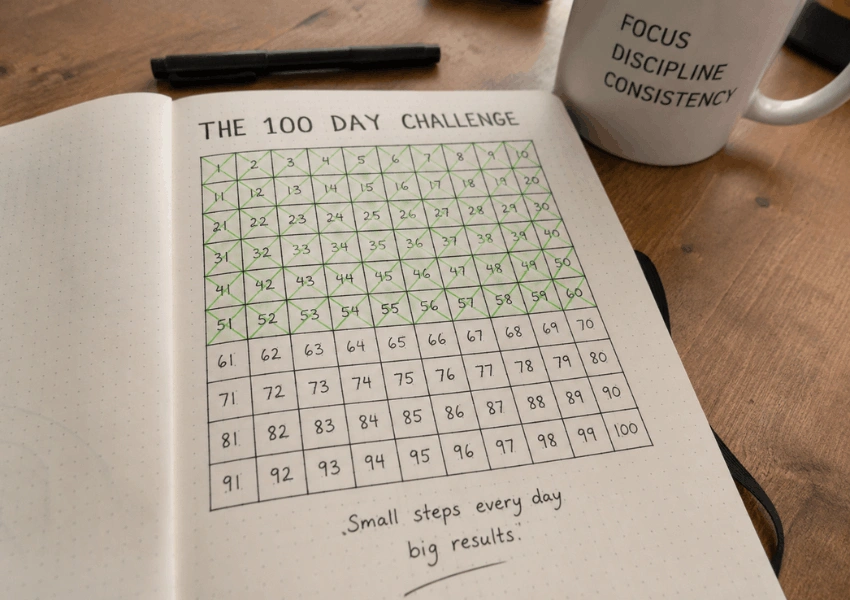
Buy a wall calendar or print a simple 100-day grid. Each day you complete your challenge action, draw an X through that day. After a few days, you’ll have a chain of X’s. Your only job: don’t break the chain.
This method works because it transforms abstract commitment into visible, tactile progress. A wall covered in red X’s is harder to abandon than a streak counter on your phone.
The Weekly Review Ritual
Every Sunday, spend 10 minutes answering three questions:
- What went well this week? (Reinforce what’s working)
- What got in the way? (Identify the real obstacles, not the excuses)
- What’s my minimum commitment for next week? (Set a floor, not a ceiling)
The weekly review is where challenges are saved. Most people quit during weeks 3–5, when the novelty has worn off and the results aren’t visible yet. A structured review keeps you honest and forward-focused.
The Progress Log
Keep a simple running log like a notes app, a Google Doc, or a notebook, where you record one sentence per day. It doesn’t have to be eloquent. Just factual:
- Day 12: Ran 3.2 miles. Legs heavy but finished.
- Day 31: Wrote 400 words. Scene still feels clunky but it exists now.
- Day 58: 25 min Duolingo + 15 min podcast. Starting to catch words I didn’t before.
By Day 100, this log becomes something remarkable: proof of who you became.
Common 100-Day Challenge Mistakes (And How to Avoid Them)
Mistake #1: Choosing a goal that’s too vague. “Get healthier” is not a 100-day challenge. “Run 3x per week and track calories 6 days a week” is.
Mistake #2: Setting the daily bar too high. If your minimum daily action requires perfect conditions, you’ll fail the first hard week. Design your challenge so your worst-day version can still check the box.
Mistake #3: Quitting after missing a day. Missing one day doesn’t break a challenge. The rule is simple: never miss twice in a row. One missed day is a blip. Two is the start of a new (bad) habit.
Mistake #4: Doing it alone. Public commitment dramatically increases follow-through. Post your challenge on social media. Tell a friend. Find an accountability partner who’s doing their own 100-day sprint. Shared stakes are a powerful motivator.
Mistake #5: Not defining what “done” looks like. Before Day 1, write down exactly what you want to be true on Day 100. Specific, measurable, honest. That definition becomes your north star when motivation inevitably dips.
What Happens After Day 100?
Here’s the beautiful secret of a 100-day challenge: the goal was never really about Day 100.
It was about building the infrastructure of a person who shows up consistently. By the time you cross the finish line, something important has happened. The daily actions, like running, the writing session, and the language practice, have stopped feeling like a sacrifice. It’s started feeling like you.
After Day 100, you have three options:
- Rest and reflect: Take a week off. Appreciate what you built. Let the habit consolidate.
- Extend the challenge: Already past the hard part? Start a fresh 100 days with a new target.
- Evolve the goal: Same domain, higher bar. You’ve earned harder.
Most people who complete a 100-day challenge start another one within a month. Not because they’re obsessive but because they’ve learned something most people never do: they can do hard things.
Start Your 100-Day Challenge Today
The only day that matters is Day 1. Not next Monday. Not January 1. Today.
Open a date calculator. Pick your start date. Add 99 days. Write down your finish date somewhere you’ll see it every morning.
Then decide: what’s the one thing that, if you did it every day for 100 days, would change your life?
That’s your challenge.
The finish line is already waiting for you.