If you’ve ever come across a date labeled “Julian” or wondered why some historical records don’t match up with modern calendars, you’re not alone.
The Julian and Gregorian calendar systems are two of the most important in human history, and understanding the difference between them matters for historians, astronomers, software developers, and anyone working with dates across cultures or centuries.
This guide breaks down everything you need to know about Julian date vs Gregorian date: their origins, how they differ, where each is still used today, and how to convert between them.
What Is the Julian Calendar?
The Julian calendar was introduced by Julius Caesar in 46 BCE and took effect on January 1, 45 BCE. It was a reform of the older Roman calendar, which had become severely misaligned with the solar year due to political manipulation of intercalary months.
Key features of the Julian calendar:
- 365 days per year, with a leap year every 4 years (adding February 29)
- Divided into 12 months, identical in structure to the modern calendar
- Average year length: 365.25 days
- Introduced the concept of a consistent, mathematically predictable calendar
The Julian calendar was a major achievement for its time and remained the standard in Europe and much of the Western world for over 1,600 years.
What Is the Gregorian Calendar?
The Gregorian calendar is the internationally accepted civil calendar used throughout most of the world today. It was introduced by Pope Gregory XIII on October 15, 1582, as a refinement of the Julian calendar.
Key features of the Gregorian calendar:
- 365 days per year, with leap years following a modified rule
- Leap year rule: A year is a leap year if it is divisible by 4, except for century years, which must be divisible by 400
- Example: 1900 was not a leap year; 2000 was
- Average year length: 365.2425 days
- Named after Pope Gregory XIII, who commissioned the reform
This small adjustment, dropping 3 leap days every 400 years, makes the Gregorian calendar far more accurate in tracking the solar year.
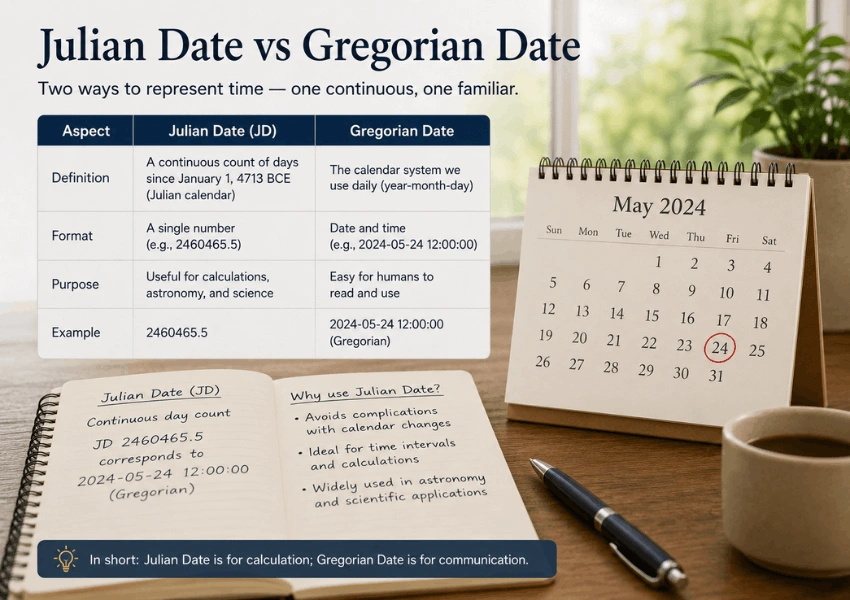
Julian Date vs Gregorian Date: Key Differences
| Feature | Julian Calendar | Gregorian Calendar |
|---|---|---|
| Introduced | 46 BCE by Julius Caesar | 1582 CE by Pope Gregory XIII |
| Leap year rule | Every 4 years | Every 4 years, except century years not divisible by 400 |
| Average year length | 365.25 days | 365.2425 days |
| Error vs solar year | ~11 minutes per year | ~26 seconds per year |
| Current date difference | 13 days behind Gregorian | Reference standard |
| Primary use today | Eastern Orthodox churches, some historical research | Worldwide civil calendar |
| Adopted globally? | No | Yes (most countries) |
The most practical difference today: the Julian calendar currently runs 13 days behind the Gregorian calendar. This gap grows by 3 days every 400 years.
Why Was the Gregorian Calendar Introduced?
The Gregorian calendar was created to solve a specific and growing problem: the drift of the Julian calendar away from the astronomical solar year.
The Julian calendar assumes a year is exactly 365.25 days long. In reality, a tropical year (the time it takes Earth to complete one orbit around the sun relative to the vernal equinox) is approximately 365.24219 days.
That’s a difference of about 11 minutes and 14 seconds per year, seemingly tiny, but it accumulates:
- Over 100 years: ~18.75 hours of drift
- Over 400 years: ~3 days of drift
- Over 1,000 years: ~7.5 days of drift
By the 16th century, the Julian calendar had drifted roughly 10 days from where it should have been. This had a direct impact on the date of Easter, which is calculated based on the spring equinox. The Catholic Church commissioned a reform to bring the calendar back into alignment.
Julian Day Number vs Julian Calendar Date
This is a common source of confusion: “Julian Date” can refer to two completely different things.
1. Julian Calendar Date
A date expressed using the Julian calendar system, the pre-Gregorian calendar introduced by Julius Caesar.
For example, the date of the Battle of Hastings in the Julian calendar is October 14, 1066.
2. Julian Day Number (JDN) / Julian Date (JD)
This is an entirely different concept used in astronomy and computing. A Julian Day Number is a continuous count of days since the beginning of the Julian Period, specifically, noon on January 1, 4713 BCE (Julian calendar).
For example:
- January 1, 2000 (noon, Gregorian) = Julian Day Number 2,451,545.0
Julian Day Numbers are widely used in:
- Astronomy (for calculating planetary positions)
- Software development (for date arithmetic)
- Scientific data logging
When someone in a technical context says “Julian date,” they almost always mean the Julian Day Number, not a date in the Julian calendar.
How to Convert Between Julian and Gregorian Dates
The offset between the Julian and Gregorian calendars depends on the century in question. Here are the key differences:
| Period | Julian is behind Gregorian by |
|---|---|
| 200–300 CE | 0 days |
| 300–500 CE | 1 day |
| 900–1100 CE | 6 days |
| 1500–1700 CE | 10 days |
| 1700–1800 CE | 11 days |
| 1800–1900 CE | 12 days |
| 1900–2100 CE | 13 days |
| 2100–2200 CE | 14 days |
Quick conversion rule (for dates after March 1, 1900):
Gregorian date = Julian date + 13 days
So if an Eastern Orthodox church celebrates a feast on a Julian date of December 25, that corresponds to January 7 on the Gregorian calendar (December 25 + 13 days).
Note: The gap will increase to 14 days starting March 1, 2100, when the Gregorian calendar skips a leap year that the Julian calendar observes.
Use our free Julian date calculator to accurately convert dates between Julian and Gregorian systems.
Frequently Asked Questions
Is the Julian calendar still used anywhere?
Yes. Several Eastern Orthodox churches use the Julian calendar for religious dates, and it is used in historical and astronomical contexts. It is, however, no longer used as a civil calendar anywhere in the world.
Why does Russia celebrate Christmas on January 7?
The Russian Orthodox Church uses the Julian calendar for religious observances. December 25 (Julian) falls on January 7 (Gregorian) due to the current 13-day offset between the two calendars.
What do “O.S.” and “N.S.” mean in historical dates?
“O.S.” stands for Old Style (Julian calendar) and “N.S.” stands for New Style (Gregorian calendar). These abbreviations are used by historians to clarify which calendar system a date belongs to.
When did England switch to the Gregorian calendar?
Great Britain and its colonies adopted the Gregorian calendar in September 1752. By that point, the Julian calendar was 11 days behind, so September 2, 1752 was followed by September 14, 1752.
Summary
The Julian and Gregorian calendars share the same basic structure: 12 months, 365 days, and a leap year system, but differ in one critical rule: how century years handle leap years. This small difference means the Julian calendar drifts roughly 3 days per 400 years relative to the solar year, while the Gregorian calendar stays tightly aligned.
Here’s what to remember:
- The Julian calendar was introduced by Julius Caesar in 46 BCE and has a simpler leap year rule (every 4 years, no exceptions)
- The Gregorian calendar was introduced in 1582 and is more accurate, skipping 3 leap years every 400 years
- The two calendars currently differ by 13 days, with Julian running behind
- The Julian calendar is still used by some Eastern Orthodox churches and in historical research
- In technical fields, “Julian date” often refers to the Julian Day Number, a completely separate concept used in astronomy and computing
- When working with historical dates, always note whether a date is Old Style (O.S.) or New Style (N.S.)
Understanding these distinctions is essential for anyone working with historical records, religious calendars, astronomical data, or international date formats.