Use this notice period calculator to quickly estimate your final notice date, last working day, and the total number of days in your notice period.
Whether your notice period is 7 days, 14 days, 1 month, 2 months, 3 months, or based on working days, this tool helps you get a clear date in seconds.
Notice Period Calculator
Calculate your estimated notice end date, last working day, and total notice length using calendar days, weeks, months, or working days.
This calculator gives a practical date estimate. Contract terms, local employment laws, probation rules, and company policies can change the actual notice period.
What Is a Notice Period?
A notice period is the amount of time an employee or employer must give before ending employment. It usually begins after resignation, termination notice, or contract cancellation.
The exact notice period can depend on your employment contract, company policy, length of service, probation period, and local labour laws.
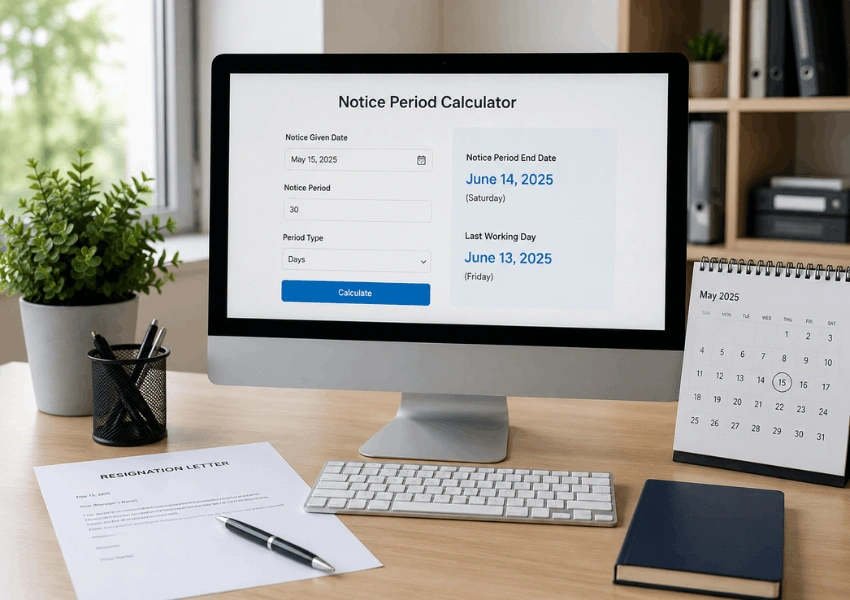
How to Use the Notice Period Calculator
Simply enter the date you gave notice, choose whether the count starts from the same day or the next day, and select your notice period.
The calculator will instantly show your estimated notice end date and last working day.
You can also add public holidays or company holidays if you want a more accurate working day calculation.
How to Calculate Your Notice Period
To calculate your notice period, start with the date notice was officially given. Then add the required number of calendar days, weeks, months, or working days.
For example, if your notice period is one month and your notice starts on 10 June, your estimated notice end date may fall around 9 July, depending on how your contract defines the counting method.
Some employers count from the same day, while others start counting from the next working day. If your final date falls on a weekend or public holiday, your last working day may be moved to the previous or next business day.
Calendar Days vs Working Days
Calendar days include every day of the week, including weekends and holidays. Working days usually exclude Saturdays, Sundays, and public holidays. This is why a 14-day notice period may end earlier than a 14 working-day notice period.
Common Notice Period Examples
Common notice periods include 1 week, 2 weeks, 30 days, 1 month, 2 months, and 3 months.
During probation, notice periods are often shorter. For senior roles or long-term employment, they may be longer.
Important Note
This notice period calculator is designed to give a helpful estimate. Always check your employment contract, HR policy, offer letter, and local employment law before making a final decision.
If you are unsure, ask your employer or a qualified legal professional to confirm your exact notice period.
Frequently Asked Questions
Does the notice period start on the day I resign?
It depends on your contract or company policy. Some employers count from the same day, while others count from the next day.
Are weekends included in a notice period?
Weekends are included if your notice period is based on calendar days. They are usually excluded if your notice period is based on working days.
What is my last working day?
Your last working day is normally the final business day before your notice period ends, especially if the end date falls on a weekend or holiday.
Try Our Notice Period Calculator Now!
To find the exact number of days between two dates, i.e., when you have given the notice and when it is ending, you can use our tool above.
It will provide you with accurate results based on your inputs.