Looking for an accurate 180 day calculator? You have come to the right place.
Below is the tool that you can use to accurately calculate 180 days from today or any date of your choice.
Related: 100 Day Calculator
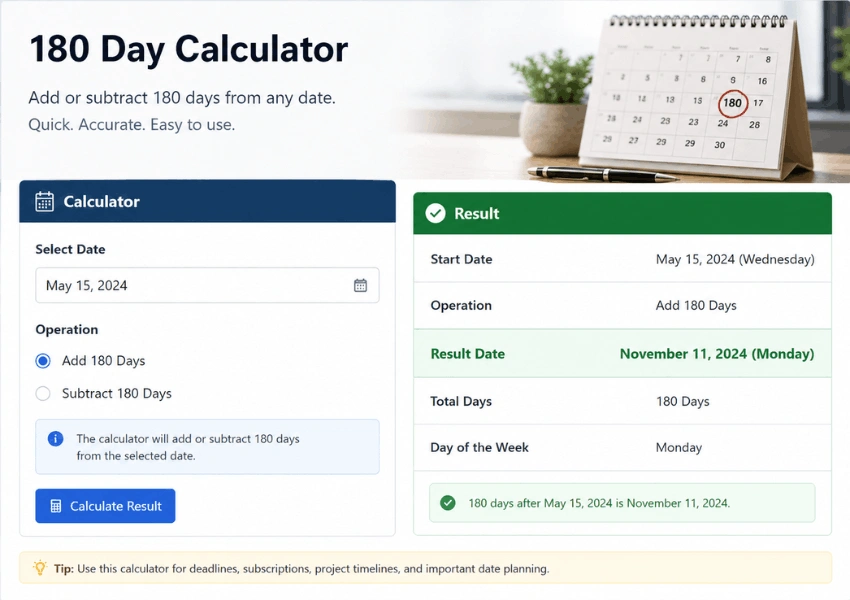
180 Day Calculator
Add or subtract 180 days, count days between dates, track deadlines, and explore quick date references, all in one tool.
Quick Reference: 180 Days From Today
Commonly referenced intervals from today's date.
| Label | Days | Date | Day of Week |
|---|
What Is a 180 Day Calculator?
180 days sounds simple enough. Six months, roughly. Half a year. But when you’re staring at a contract, a visa stamp, a return policy, or a court filing deadline, “roughly six months” isn’t good enough.
You need the exact date, the specific Tuesday or Friday that marks the boundary between compliant and non-compliant, valid and expired.
That’s the gap this calculator fills.
Why 180 Days Doesn’t Always Mean 6 Months
Here’s something that catches people off guard: 180 days and 6 months are not the same thing.
Six months from January 1st lands on July 1st, that’s 181 days in a non-leap year. Six months from August 31st? Good luck pinning that to a calendar date at all.
Months have 28, 29, 30, or 31 days, which makes “add 6 months” an inherently fuzzy instruction.
How to Calculate 180 Days From a Date (Step by Step)
If you ever need to do this manually or want to understand exactly what the calculator is doing, here’s the process.
Step 1: Identify your start date.
This is the triggering event: the date a contract was signed, a visa was stamped, a claim event occurred, or a challenge began.
Step 2: Add 180 to the day number.
The most reliable manual method is to use a day-of-year approach. Convert your start date to its ordinal day (e.g., February 15th = day 46), add 180, then convert back, accounting for month lengths and leap years.
Step 3: Check for year boundaries.
If your 180-day count crosses from one year into the next (which it does for any start date after July 5th in a non-leap year), you need to account for the remaining days in the current year and carry over into the next.
Step 4: Verify the day of the week.
In some legal and financial contexts, if the 180th day falls on a weekend or public holiday, the deadline shifts to the next business day. Knowing the day of the week matters.
As you can see, the manual process has multiple steps where an error can creep in. The 180 day calculator handles all of this instantly and accurately.
Common Mistakes When Counting 180 Days
Even careful people make these errors. Knowing them in advance helps you avoid them.
1. Counting the start date as Day 1
The standard convention is that Day 1 is the day after the triggering event. If something happens on March 1st, the 180-day period begins on March 2nd and ends on August 28th or 29th (depending on the year), not August 27th.
However, some legal instruments specifically include the start date; always check the source document.
2. Confusing 180 days with 6 months
As covered above, these are not equivalent. 180 days from March 31st is September 27th, not September 30th, which would be “6 months later.”
3. Forgetting leap years
If your 180-day window crosses February 29th, your end date shifts by one day compared to a non-leap year. The calculator handles this automatically.
4. Using approximate month math
“About 6 months,” calculated by adding roughly 30 days per month, introduces drift. Over 180 days, this can throw you off by up to 3–4 days.
5. Not checking the day of the week
A 180-day deadline that falls on a Sunday may or may not shift to Monday, depending on the jurisdiction or contract. Always confirm.
Frequently Asked Questions
How many weeks is 180 days?
180 days is exactly 25 weeks and 5 days, or approximately 25.71 weeks.
How many months is 180 days?
Approximately 5 months and 29 days, or about 5.92 months. It’s close to 6 months but not exactly 6 calendar months.
Is 180 days the same as half a year?
Not precisely. Half of a standard 365-day year is 182.5 days. Half of a 366-day leap year is 183 days. 180 days is about 2–3 days shorter than half a year.
What date is 180 days from today?
Use the 180 day calculator above; it updates to today’s date automatically and gives you the exact result in seconds.
Try This 180 Day Calculator Now!
This calculator uses standard calendar arithmetic and is designed to be accurate for general planning and reference purposes. It accounts for leap years, month-length variation, and business-day exclusions.
Use this tool to get your bearings and build confidence in your planning. For high-stakes deadlines, treat the result as the starting point for your verification, not the final word.