You order something online and the store says delivery takes “5 to 7 business days.” Your bank tells you a transfer will clear in “3 calendar days.” A contract gives you “10 business days” to respond. These phrases show up everywhere, yet a surprising number of people aren’t entirely sure what they mean, or how to count them correctly.
Understand business days vs calendar days with this easy guide covering workdays, weekends, holidays, and deadline examples.
Related: Notice Period Calculator
What Are Calendar Days?
Calendar days are exactly what they sound like: every single day on the calendar, counted one by one. That means Mondays through Sundays, weekends, public holidays, Christmas Day, all of it counts.
If someone says “you have 30 calendar days,” they mean 30 actual days from today, no exceptions. Day 1 is tomorrow (or sometimes today, depending on the context), and you count forward until you hit day 30.
Example: A landlord gives you a 30-calendar-day notice on March 1. Your deadline is March 31, regardless of whether any of those days fall on a weekend or holiday.
Calendar days are used when precision matters and there’s no reason to exclude non-working days. Legal deadlines, lease agreements, insurance claims, and medical timeframes almost always run on calendar days.
What Are Business Days?
Business days, sometimes called working days or weekdays, are Monday through Friday, not counting weekends or official public holidays.
The standard business week in most countries runs five days: Monday, Tuesday, Wednesday, Thursday, Friday. Saturday and Sunday don’t count. Neither do public holidays like New Year’s Day, Independence Day, or Christmas.
Example: A company says they’ll respond to your complaint within 5 business days. You submit it on a Wednesday. That means: Thursday (day 1), Friday (day 2), skip the weekend, Monday (day 3), Tuesday (day 4), Wednesday (day 5). You should hear back by the following Wednesday.
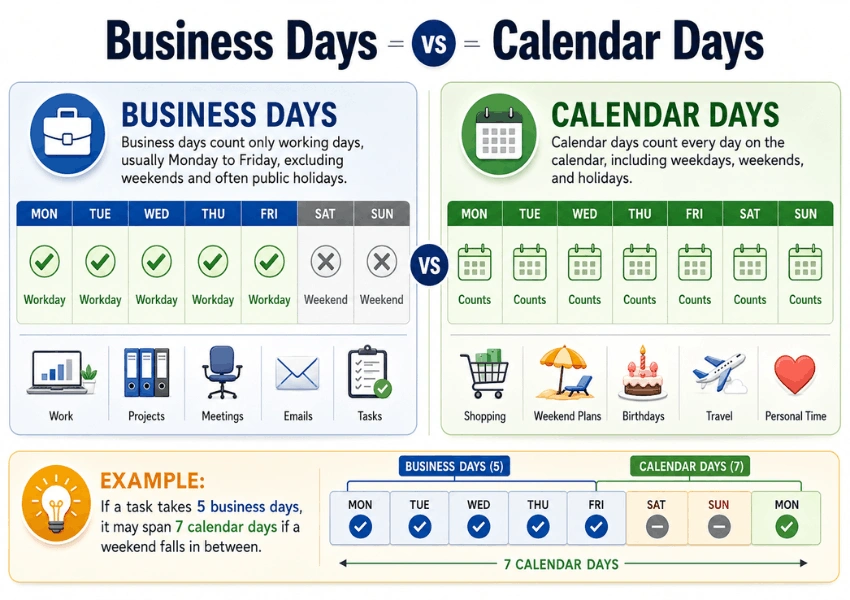
Business Days vs Calendar Days: Side-by-Side
| Business Days | Calendar Days | |
|---|---|---|
| Weekends included? | No | Yes |
| Holidays included? | No | Yes |
| Typical use | Shipping, banking, contracts | Leases, medical, legal deadlines |
| 5 days = how long? | At least 7 calendar days | Exactly 5 days |
| More predictable? | Depends on holidays | Yes, always fixed |
Read: How Many Working Days in a Year?
How to Count Business Days Correctly
This is where people most often make mistakes. Here’s a simple method:
- Start from the day after the event; in most cases, the day something happens doesn’t count as day 1.
- Skip Saturdays and Sundays, these are never business days.
- Skip public holidays; any official holiday in your country (or the company’s country) doesn’t count.
- Count forward until you reach the required number.
Worked example, 10 business days starting on a Monday:
| Day | Date | Count? |
|---|---|---|
| Monday | June 2 | Day 1 |
| Tuesday | June 3 | Day 2 |
| Wednesday | June 4 | Day 3 |
| Thursday | June 5 | Day 4 |
| Friday | June 6 | Day 5 |
| Saturday | June 7 | Skip |
| Sunday | June 8 | Skip |
| Monday | June 9 | Day 6 |
| Tuesday | June 10 | Day 7 |
| Wednesday | June 11 | Day 8 |
| Thursday | June 12 | Day 9 |
| Friday | June 13 | Day 10 ✓ |
So 10 business days from Monday, June 2, lands on Friday, June 13, a span of 12 calendar days.
How Many Calendar Days Is 5 Business Days?
People search for this a lot, and the honest answer is: it depends on where the 5 business days fall in the week.
- If you start on a Monday, 5 business days = exactly 7 calendar days (lands on Friday).
- If you start on a Wednesday, 5 business days = 9 calendar days (lands on the Tuesday of the next week).
- If a public holiday falls in that stretch, add one more calendar day for each holiday.
The minimum is always 5 calendar days (if all 5 fall Mon–Fri with no holidays). In practice, it’s usually 7 to 9 calendar days.
When Do You Use Business Days vs Calendar Days?
Business days are typically used for:
- Shipping and delivery – couriers and fulfillment warehouses only operate on weekdays, so estimated delivery windows are always in business days.
- Banking transactions – wire transfers, ACH payments, and check clearance run on banking days (weekdays when the bank is open).
- Customer service response times – most companies commit to response windows in business days because their teams aren’t working on weekends.
- Employment contracts – notice periods, onboarding timelines, and payroll cutoffs often use business days.
- Government processing – visa applications, permit approvals, and agency responses are measured in business days.
Calendar days are typically used for:
- Legal deadlines – court filings, statute of limitations periods, and contract response windows often run on calendar days to remove ambiguity.
- Rental and lease agreements – notice to vacate, rent due dates, and lease start/end dates count every day.
- Medical and pharmaceutical – dosage intervals, clinical trial timelines, and drug expiration dates always use calendar days.
- Insurance claims – many policies specify how many calendar days you have to file after an incident.
- Subscriptions and billing cycles – monthly and annual renewal dates are based on calendar days.
Public Holidays: The Tricky Part of Business Days
Public holidays are the most commonly overlooked factor when counting business days. A business day only counts if businesses are actually open, and that varies by country, state, and even industry.
For example:
- In the US, federal holidays like Thanksgiving and Memorial Day aren’t business days for most companies.
- In Germany, regional holidays (like certain Catholic feast days) apply in some states but not others.
- Banks often observe more holidays than regular businesses.
- Some industries (like healthcare or essential retail) operate on holidays, so for them, those days may count.
Practical tip: If you’re counting business days for something time-sensitive, a contract deadline, a legal response, or a refund window, always check which holidays fall in that period and confirm whether the other party observes them.
Does the Starting Day Count?
This trips a lot of people up. Whether or not “day 0” (the day something happens) counts as day 1 depends on the context.
In most shipping and commercial contexts, the day you place an order or the day the clock starts does NOT count as business day 1. The next business day is day 1.
In legal and contractual contexts, you need to read the exact language. Some contracts say “within 10 business days of receipt,” which may or may not include the day of receipt, and courts have ruled differently on this depending on jurisdiction.
When in doubt, treat the starting day as day 0 and start counting the next business day as day 1. This gives you the most conservative (and safest) estimate.
Why This Distinction Actually Matters
Getting business days and calendar days mixed up can cause real problems:
- Missing a legal deadline because you counted weekends that didn’t count.
- Expecting a package too early because you thought 5 business days meant 5 days.
- A contract dispute over whether a response was submitted “on time.”
- A financial penalty for missing a payment window you miscalculated.
The difference between 5 business days and 5 calendar days can be anywhere from 2 to 4 extra days in practice. Over a 30-day window, the gap can stretch to over a week.
Frequently Asked Questions
Are Saturday and Sunday business days?
No, Saturday and Sunday are not business days in most countries. The standard business week runs Monday through Friday.
How many business days are in a month?
A typical month has between 20 and 23 business days, depending on how the weekends fall and how many public holidays occur that month. A 31-day month with no holidays might have 23 business days; a month like February with Presidents’ Day (in the US) might have as few as 19.
Do business days include bank holidays?
No. Bank holidays are excluded from business day counts; in fact, “banking days” is an even stricter subset that excludes any day a bank is closed. If your bank says a transfer takes 3 business days, they mean 3 days the bank itself is open and processing transactions.
What’s the difference between business days and working days?
In most contexts, “business days” and “working days” mean the same thing: Monday through Friday, excluding public holidays.
Quick Reference Summary
- Calendar days = every day, no exceptions.
- Business days = Monday through Friday only, excluding public holidays.
- 5 business days typically equals 7 to 9 calendar days in practice.
- 30 business days is roughly 6 weeks on the calendar.
- When in doubt about which applies, read the exact wording — or ask.
Understanding the difference saves you from missed deadlines, wrong delivery expectations, and potential disputes. It’s one of those small things that matter more than most people realize until they get it wrong.