Whether you’re calculating annual salary, planning a project timeline, or managing employee leave, knowing how many working days are in a year is essential.
The short answer: approximately 260 working days but the exact number depends on holidays, leap years, and your country.
This guide breaks it all down.
The Quick Answer
| Year | Total Days | Weekends | Working Days (Before Holidays) |
|---|---|---|---|
| 2024 | 366 (leap) | 104 | 262 |
| 2025 | 365 | 104 | 261 |
| 2026 | 365 | 104 | 261 |
Note: These figures represent weekdays only, before subtracting public holidays. After accounting for U.S. federal holidays (typically 10–11), the working day count drops to around 250–252 per year.
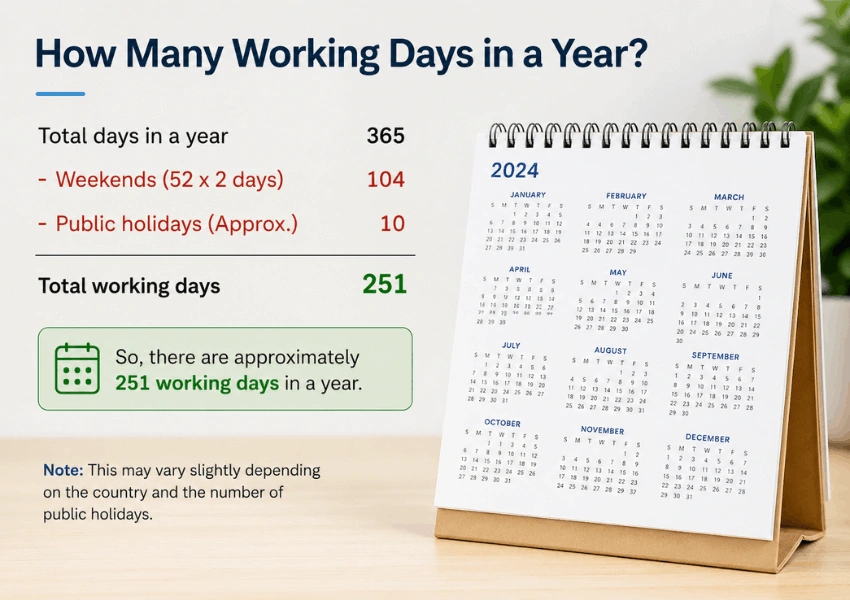
How to Calculate Working Days in a Year
The formula is straightforward:
Working Days = Total Days in Year − Weekend Days − Public Holidays
Step 1: Subtract Weekends
A standard year has 52 weeks, which means 104 weekend days (52 Saturdays + 52 Sundays).
A leap year occasionally adds one extra weekend day, depending on which day January 1 falls on.
Step 2: Subtract Public Holidays
Public holidays vary by country and employer. In the United States, there are 11 federal public holidays.
When you subtract these from the 261–262 weekdays, you get roughly 250–251 working days per year.
Step 3: Account for Leap Years
A leap year has 366 days instead of 365, adding one extra day. If that day falls on a weekday, you gain one additional working day.
Working Days by Country (2025 Estimates)
Public holidays differ significantly around the world, which changes the effective number of working days.
| Country | Approx. Public Holidays | Estimated Working Days (2025) |
|---|---|---|
| United States | 11 | ~250 |
| United Kingdom | 8–9 | ~252 |
| Germany | 9–13 (varies by state) | ~248–252 |
| France | 11 | ~250 |
| Canada | 9–10 | ~251 |
| Australia | 8–12 (varies by state) | ~249–253 |
| India | 3 (national) + regional | ~248–258 |
| Japan | 16 | ~245 |
Always verify the official holiday calendar for your region, as holidays that fall on weekends are sometimes moved (“observed”) to the nearest weekday.
Working Days in 2025: Month-by-Month Breakdown (US)
| Month | Working Days |
|---|---|
| January | 23 |
| February | 20 |
| March | 21 |
| April | 22 |
| May | 21 |
| June | 21 |
| July | 23 |
| August | 21 |
| September | 22 |
| October | 23 |
| November | 19 |
| December | 23 |
| Total | 260 |
Based on U.S. standard weekdays. Subtract federal holidays observed in each month for net working days.
Why Does It Matter? Common Use Cases
1. Salary and Payroll Calculations
If you’re on a daily rate or calculating prorated salaries, the number of working days directly affects pay. A common method:
- Annual salary ÷ 260 working days = daily rate
2. Project Planning and Deadlines
Project managers use working days to set realistic timelines. A “30 business day” deadline is very different from a “30 calendar day” deadline; it’s roughly 6 weeks versus just over 4 weeks.
3. Employee Leave Entitlement
Annual leave is almost always measured in working days, not calendar days. In many countries, a standard entitlement is 20–28 working days per year.
4. Contract and Legal Timeframes
Many contracts specify notice periods, delivery windows, and response times in business days.
Understanding the difference between business days and calendar days can be legally significant.
Working Days vs. Business Days: Is There a Difference?
The terms are often used interchangeably, but there is a subtle distinction:
- Working days typically refer to Monday–Friday, regardless of holidays.
- Business days usually mean Monday–Friday, excluding public holidays.
In most practical contexts, HR, payroll, and contracts business days are the more precise term if holidays are meant to be excluded.
How Part-Time Workers Calculate Working Days
If you work fewer than 5 days a week, your working days per year are proportionally lower:
| Work Pattern | Days/Week | Approx. Working Days/Year |
|---|---|---|
| Full-time | 5 | ~260 |
| 4-day week | 4 | ~208 |
| 3-day week | 3 | ~156 |
| 2-day week | 2 | ~104 |
Frequently Asked Questions
How many working hours are in a year?
Based on a standard 8-hour workday and ~260 working days:
260 × 8 = 2,080 working hours per year
This is the figure commonly used in the U.S. for full-time employment. After subtracting 10 federal holidays, it’s closer to 2,000 hours.
Does a leap year add a working day?
It depends. 2024, for example, had 366 days. Since January 1, 2024, was a Monday, the extra day (February 29) fell on a Thursday, adding one extra working day compared to a non-leap year, for a total of 262 working days before holidays.
How many working days are in a month on average?
Divide 260 by 12: roughly 21–22 working days per month. Some months (like January and October in 2025) have 23 working days, while November tends to have fewer due to the Thanksgiving holiday in the U.S.
What is the minimum number of working days in a year?
In rare cases where a country observes many public holidays and they all fall on weekdays, the number of working days can dip below 240. Japan, for instance, has 16 national holidays, bringing its working day count to around 245.
Key Takeaways
- A standard year contains 260–262 working days (weekdays only).
- After U.S. federal holidays, that figure drops to approximately 250 working days.
- The exact count depends on the year, country, and observed holidays.
- Working days are used for salary calculations, project timelines, leave entitlements, and legal contracts.
- Part-time employees calculate working days proportionally based on their contracted days per week.
Last updated: 2025. Always check your local government’s official holiday schedule for the most accurate figures.